

Districts Relying More on Data to Identify Gifted Students

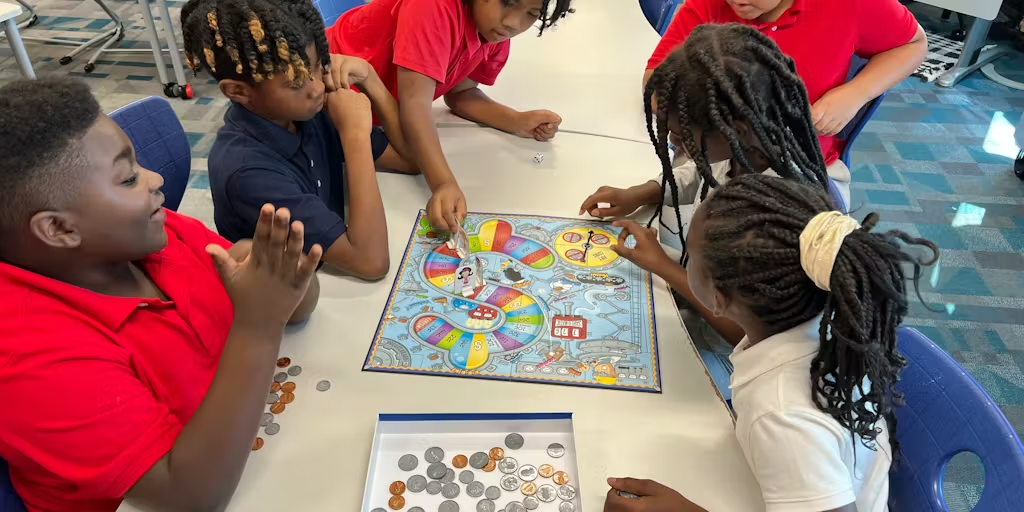
A group of third grade students gather around a board game on a Wednesday afternoon in a Charleston classroom, grabbing game pieces, discussing potential moves and reading out playing cards. The games are not Monopoly, Sorry, or any others of yore – they’re focused on identifying, and boosting, students’ strengths and weaknesses.
It’s part of a shift in school districts’ gifted and talented programs. While many programs focused on a small group of high achieving students, instructors across the nation are now focusing more on inclusion, using data to help them zero in on students’ talents, a method that has the potential of capturing more students for advanced instruction.
For Vanessa Hill, the gifted education coordinator for Amphitheater Public School District in Tucson, Arizona, focusing on strengths and weaknesses helps to solve what she sees as a universal problem with gifted identification.
“Something I’ve been thinking deeply about that tends to be a universal problem is that gifted identification does not match the metrics of your district,” says Vanessa Hill, the gifted education coordinator for Amphitheater Public School District in Tucson, Arizona. “I’m constantly thinking of that, so our demographics can get closer. This new tactic is about exposure to critical thinking and reasoning – what does that look like, how to reason through a problem?”
Re-assessing the methods and ultimately changing the definition of “gifted” comes as some question the value of standardized tests and a push-and-pull to diversify programs.
The Shift In Gifted and Talented
The gifted and talented programs run the gamut of names and acronyms depending on the district, including advanced learning program, TAG (talented and gifted), LEAP (Learning Enrichment Alternative Program) or REACH (Realizing Excellence through Academic and Creative Help), among others.
Regardless of the name, the program has undergone several major shifts over the last few decades. Schools previously often only selectively tested students, often at the behest of involved parents or by a teacher recommendation. That brought a large amount of inequity in the programs, with many moving to a universal screening practice. Some states, including Washington and Missouri, made it a state mandate to test all students while in elementary school. The screening practice itself evolved from an IQ test to aptitude and ability tests, though how accurate those are is up for debate.
“Society is really unequal along socioeconomic and racial and ethnic lines, and these tests are just reflecting that,” says Scott Peters, director of research consulting at NWEA, a nonprofit education assessment organization. “You can change tests all day long, but at the end of the day, you can’t give some kids three years of $40,000-a-year preschool and also wonder why this kid that’s never been to school until first grade doesn’t do as well.”
Often, schools’ gifted and talented programs do not represent their overall school population and instead skew heavily toward white and Asian students. Zohran Mamdani, the widely-watched mayor of New York City, made it part of his platform to phase out gifted and talented programs because of the inequity.
“Ultimately, my administration would aim to make sure that every child receives a high-quality early education that nurtures their curiosity and learning,” he said in a 2025 statement to the New York Times.
There is no silver bullet test that accounts for inequality and a child’s upbringing, although Peters said when factors such as income, race and other equity gaps are controlled in tests, most inequities disappear.
“This isn’t a factor of, ‘Oh, there are students of color scoring high, but they’re still not getting in,’” he says. “It’s that there’s not enough students of color scoring high because of that larger societal inequality issue.”
Because of the often-skewed gifted and talented population, schools are shifting toward “talent development” with all students, versus focusing on strengthening some students’ already solid skills.
“Because of the baggage of the past, we’re moving toward a new perspective where we’re identifying the strengths of students — whether academic, social or emotional — versus people for a program,” says Kristen Seward, clinical professor in gifted, talented and creative studies at Purdue University. “And I think this twist in how we approach education as gifted researchers is going to benefit everybody.”
Using Data for ‘Talent Development’
Developing talent for gifted programs, much like the name itself, varies depending on the district. Seward says many teachers have enriched curriculums, which enhance things like vocabulary, science and social studies — topics that have been put on the back burner over the years in favor of standardized testing. Teachers are trained to spot students’ strengths and respond to those, which in turn, helps with students’ weaknesses.
For example, if a student has a strong vocabulary but struggles in math, the teacher might focus on math vocabulary during math class to put the lesson on a level the child understands.

Photo credit/Vanessa Hill
“I don’t want it to turn into a thing where the teacher is the gate, and if they don’t open the gate, then the students don’t get identified – which has been a problem,” Seward says. “We have to train teachers to be talent scouts, presenting the enriched curriculum. Hopefully it’s not something additional, but something they’d naturally do in their role.”
Elizabeth McLaurin Uptegrove, now the assistant academic director in Charleston County School District, created a “stretch or support” system that involves the games the students played in the aforementioned classroom. When Uptegrove first arrived in Charleston’s school district, South Carolina used to require all second grade students be tested for the gifted and talented program. But after that year, selection changed to a nomination system.
“Which sounds elitist, and it is,” she says, adding white, affluent children were three times more likely to be in the programs.
She pushed for universal testing again for all fourth grade students, which yielded three times as many students identified as gifted, jumping from 40 fourth graders to 150 across the district. Several schools across the country have adopted similar stretch-or-support systems.
But Uptegrove’s efforts go beyond identifying candidates for gifted programs through teacher observation: her game-based system uses data. With the aptitude test, there are verbal, quantitative and nonverbal subsections. The tests indicate if a child is low or high achieving in those areas. Then the children are placed in groups with those of similar abilities to play games that can enhance those skills.

Photo credit/Elizabeth McLaurin Uptegrove
“Typically a teacher is not very well-equipped to come up with activities or lessons that can actually reach their level of thinking ability and games do that really quickly, in a way that’s not as boring for children as a typical worksheet,” Uptegrove says. “That’s where the magic of the games comes in. We’re making rigorous, hard thinking almost irresistible so students are willing to do the activity for longer.”
Hill, the Arizona-based education coordinator, initially implemented Uptegrove’s game strategy across third grade classrooms in five schools: three Title 1 schools and two non-Title 1. She says the schools that have the strength or stretch program in place have higher passing rates of “proficient” or “highly proficient” scores than those who do not.
“To me, it’s the difference between being a passive learner and active learner; by being able to engage in the games, it’s more active learning,” Hill says. “You raise the exposure to critical thinking and are taught to apply those skills to any situation, whether it’s on an achievement test or on the playground with a friend.”
The Future of the Program
Both researchers and teachers acknowledge the “talent development” approach to gifted and talented programs is far from perfect. It is often costly, whether it is buying the games, instilling teacher training or taking out time from testing. Hill pointed to four schools within her district that are closing this year because of financial constraints.
“Ordering the games is no small cost; I feel so blessed it’s that level of importance that we will find the funds,” she says. “As far as critical thinking games, yes that was missing. It is a hole we were filling. I think that while the core curriculum is doing its best, it can oftentimes be a bit surface level.”
Uptegrove agrees, saying she believes the talent development method is becoming more popular, but “there’s a long way to go in belief and funding for it.”
Peters, who has long studied the best educational methods and practices, believes the shift in gifted and talented is a good step. But he has concerns about the larger moves needed for lasting impact.
“It’s easy to have a 30-minute gifted program; it’s hard to have a second through eighth grade math development pipeline involving everyone in the school,” he says. “And advanced learning isn’t enough of a priority for most schools.”